BST
Table of Contents
- 700. Search in a Binary Search Tree (Easy)
- 98. Validate Binary Search Tree (Medium)
- 530. Minimum Absolute Difference in BST (Easy)
- 501. Find Mode in Binary Search Tree (Easy)
- 235. Lowest Common Ancestor of a Binary Search Tree (Medium)
- 701. Insert into a Binary Search Tree (Medium)
- 450. Delete Node in a BST (Medium)
- 669. Trim a Binary Search Tree (Medium)
- 108. Convert Sorted Array to Binary Search Tree (Easy)
- 109. Convert Sorted List to Binary Search Tree (Medium)
- 538. Convert BST to Greater Tree (Medium)
- 230. Kth Smallest Element in a BST (Medium)
- 173. Binary Search Tree Iterator (Medium)
- 1586. Binary Search Tree Iterator II (Medium) 👑
700. Search in a Binary Search Tree
"""
### Binary Search Tree

1. Binary Tree
2. Left subtree of a node contains only nodes with keys less than the node's key
3. Right subtree of a node contains only nodes with keys greater than the node's key
4. The left and right subtree each must also be a binary search tree
5. There must be no duplicate nodes
6. Inorder traversal of a BST gives a sorted list of keys
"""

from typing import Optional

from binarytree import build


class TreeNode:
    def __init__(self, val=0, left=None, right=None):
        self.val = val
        self.left = left
        self.right = right


# 1. Recursive
def searchBSTRecursive(root: Optional[TreeNode], val: int) -> Optional[TreeNode]:
    if not root:
        return None

    if root.val > val:
        return searchBSTRecursive(root.left, val)

    elif root.val < val:
        return searchBSTRecursive(root.right, val)

    else:
        return root


# 2. Iterative
def searchBSTIterative(root: Optional[TreeNode], val: int) -> Optional[TreeNode]:
    while root:
        if root.val > val:
            root = root.left
        elif root.val < val:
            root = root.right
        else:
            return root
    return None


root = [4, 2, 7, 1, 3]
val = 2
root = build(root)
print(root)
#     __4
#    /   \
#   2     7
#  / \
# 1   3
print(searchBSTRecursive(root, val))
#   2
#  / \
# 1   3
print(searchBSTIterative(root, val))
#   2
#  / \
# 1   3
98. Validate Binary Search Tree
from itertools import pairwise
from math import inf
from typing import Optional

from binarytree import Node as TreeNode
from binarytree import build


def isValidBST1(root: Optional[TreeNode]) -> bool:
    inorder = []  # inorder traversal

    def dfs(node):
        if not node:
            return None
        dfs(node.left)
        inorder.append(node.val)
        dfs(node.right)

    dfs(root)

    for a, b in pairwise(inorder):
        if a >= b:
            return False

    return True


def isValidBST2(root: Optional[TreeNode]) -> bool:
    if not root:
        return True
    pre = -inf

    def dfs(node):
        if not node:
            return True
        if not dfs(node.left):
            return False

        nonlocal pre
        if node.val <= pre:
            return False
        pre = node.val

        return dfs(node.right)

    return dfs(root)


if __name__ == "__main__":
    root = [5, 1, 4, None, None, 3, 6]
    root = build(root)
    print(root)
    #   5__
    #  /   \
    # 1     4
    #      / \
    #     3   6
    assert not isValidBST1(root)  # [1, 5, 3, 4, 6]
    assert not isValidBST2(root)  # [1, 5, 3, 4, 6]
#include <cassert>
#include <vector>
using namespace std;

struct TreeNode {
    int val;
    TreeNode *left;
    TreeNode *right;
    TreeNode() : val(0), left(nullptr), right(nullptr) {}
    TreeNode(int x) : val(x), left(nullptr), right(nullptr) {}
    TreeNode(int x, TreeNode *left, TreeNode *right)
        : val(x), left(left), right(right) {}
};

class Solution {
   private:
    vector<int> inorder;
    bool check(vector<int> inorder) {
        int n = inorder.size();
        if (n <= 1) return true;
        for (int i = 1; i < n; i++) {
            if (inorder[i] <= inorder[i - 1]) return false;
        }
        return true;
    }

   public:
    bool isValidBST(TreeNode *root) {
        auto dfs = [&](auto &&self, TreeNode *node) -> void {
            if (!node) return;

            self(self, node->left);
            inorder.push_back(node->val);
            self(self, node->right);
        };

        dfs(dfs, root);

        return check(inorder);
    }
};

int main() {
    Solution s;
    TreeNode *root = new TreeNode(2);
    root->left = new TreeNode(1);
    root->right = new TreeNode(3);
    assert(s.isValidBST(root) == true);

    root = new TreeNode(5);
    root->left = new TreeNode(1);
    root->right = new TreeNode(4);
    root->right->left = new TreeNode(3);
    root->right->right = new TreeNode(6);
    assert(s.isValidBST(root) == false);

    root = new TreeNode(5);
    root->left = new TreeNode(4);
    root->right = new TreeNode(6);
    root->right->left = new TreeNode(3);
    root->right->right = new TreeNode(7);
    assert(s.isValidBST(root) == false);

    return 0;
}
530. Minimum Absolute Difference in BST
from typing import Optional

from binarytree import build


class TreeNode:
    def __init__(self, val=0, left=None, right=None):
        self.val = val
        self.left = left
        self.right = right


def getMinimumDifference(root: Optional[TreeNode]) -> int:
    res = float("inf")
    pre = float("-inf")

    def dfs(node):  # inorder traversal
        if not node:
            return

        dfs(node.left)

        nonlocal res, pre
        res = min(res, node.val - pre)
        pre = node.val

        if res == 1:  # the minimum possible difference
            return

        dfs(node.right)

    dfs(root)

    return res


if __name__ == "__main__":
    root = [4, 2, 6, 1, 3]
    root = build(root)
    print(root)
    #     __4
    #    /   \
    #   2     6
    #  / \
    # 1   3
    assert getMinimumDifference(root) == 1
501. Find Mode in Binary Search Tree
from typing import List, Optional

from binarytree import build


class TreeNode:
    def __init__(self, val=0, left=None, right=None):
        self.val = val
        self.left = left
        self.right = right


def findMode(root: Optional[TreeNode]) -> List[int]:
    hashmap = dict()

    def dfs(node):
        if not node:
            return None
        dfs(node.left)
        if node.val not in hashmap:
            hashmap[node.val] = 1
        else:
            hashmap[node.val] += 1
        dfs(node.right)

    dfs(root)
    max_counts = max(hashmap.values())
    result = []

    for key, value in hashmap.items():
        if value == max_counts:
            result.append(key)

    return result


root = [1, None, 2, None, None, 2]
root = build(root)
print(root)
# 1__
#    \
#     2
#    /
#   2
print(findMode(root))  # [2]
235. Lowest Common Ancestor of a Binary Search Tree
from binarytree import build


class TreeNode:
    def __init__(self, val=0, left=None, right=None):
        self.val = val
        self.left = left
        self.right = right


def lowestCommonAncestor(root: "TreeNode", p: "TreeNode", q: "TreeNode") -> "TreeNode":
    while root:
        if root.val > p.val and root.val > q.val:
            root = root.left
        elif root.val < p.val and root.val < q.val:
            root = root.right
        else:
            return root


root = [6, 2, 8, 0, 4, 7, 9, None, None, 3, 5]
root = build(root)
p = root.left
q = root.right
print(root)
#     ______6__
#    /         \
#   2__         8
#  /   \       / \
# 0     4     7   9
#      / \
#     3   5
print(lowestCommonAncestor(root, p, q))
#     ______6__
#    /         \
#   2__         8
#  /   \       / \
# 0     4     7   9
#      / \
#     3   5
701. Insert into a Binary Search Tree
from typing import Optional


class TreeNode:
    def __init__(self, val=0, left=None, right=None):
        self.val = val
        self.left = left
        self.right = right


def insertIntoBST(root: Optional[TreeNode], val: int) -> Optional[TreeNode]:
    if root is None:
        return TreeNode(val)

    if root.val > val:
        root.left = insertIntoBST(root.left, val)
    if root.val < val:
        root.right = insertIntoBST(root.right, val)

    return root


root = TreeNode(4)
root.left = TreeNode(2)
root.right = TreeNode(6)
root.left.left = TreeNode(1)
root.left.right = TreeNode(3)
#     __4
#    /   \
#   2     6
#  / \
# 1   3

insertIntoBST(root, 5)
#     __4
#    /   \
#   2     6
#  / \   /
# 1   3 5
450. Delete Node in a BST
from typing import Optional


class TreeNode:
    def __init__(self, val=0, left=None, right=None):
        self.val = val
        self.left = left
        self.right = right


def deleteNode(root: Optional[TreeNode], key: int) -> Optional[TreeNode]:
    if root is None:
        return root

    if root.val == key:
        if root.left is None and root.right is None:
            return None
        elif root.left is None:
            return root.right
        elif root.right is None:
            return root.left
        else:
            cur = root.right
            while cur.left is not None:
                cur = cur.left
            cur.left = root.left
            return root.right

    if root.val > key:
        root.left = deleteNode(root.left, key)
    if root.val < key:
        root.right = deleteNode(root.right, key)

    return root


root = TreeNode(5)
root.left = TreeNode(3)
root.right = TreeNode(6)
root.left.left = TreeNode(2)
root.left.right = TreeNode(4)
root.right.right = TreeNode(7)
#     __5
#    /   \
#   3     6
#  / \     \
# 2   4     7

deleteNode(root, 3)
#     __5
#    /   \
#   4     6
#  /       \
# 2         7
669. Trim a Binary Search Tree
from typing import Optional


class TreeNode:
    def __init__(self, val=0, left=None, right=None):
        self.val = val
        self.left = left
        self.right = right


def trimBST(root: Optional[TreeNode], low: int, high: int) -> Optional[TreeNode]:
    if root is None:
        return None

    if root.val < low:
        return trimBST(root.right, low, high)
    if root.val > high:
        return trimBST(root.left, low, high)

    root.left = trimBST(root.left, low, high)
    root.right = trimBST(root.right, low, high)

    return root


root = TreeNode(3)
root.left = TreeNode(0)
root.right = TreeNode(4)
root.left.right = TreeNode(2)
root.left.right.left = TreeNode(1)
#     __3
#    /   \
#   0     4
#    \
#     2
#    /
#   1

trimBST(root, 1, 3)
#     __3
#    /
#   2
#  /
# 1
108. Convert Sorted Array to Binary Search Tree
from typing import List, Optional


class TreeNode:
    def __init__(self, val=0, left=None, right=None):
        self.val = val
        self.left = left
        self.right = right


def sortedArrayToBST(nums: List[int]) -> Optional[TreeNode]:
    if len(nums) == 0:
        return None

    mid = len(nums) // 2
    root = TreeNode(nums[mid])

    root.left = sortedArrayToBST(nums[:mid])
    root.right = sortedArrayToBST(nums[mid + 1 :])

    return root


nums = [-10, -3, 0, 5, 9]
root = sortedArrayToBST(nums)
#      0
#     / \
#   -3   9
#   /   /
# -10  5
#include <vector>
using namespace std;

struct TreeNode {
    int val;
    TreeNode* left;
    TreeNode* right;
    TreeNode() : val(0), left(nullptr), right(nullptr) {}
    TreeNode(int x) : val(x), left(nullptr), right(nullptr) {}
    TreeNode(int x, TreeNode* left, TreeNode* right)
        : val(x), left(left), right(right) {}
};

class Solution {
   public:
    TreeNode* sortedArrayToBST(vector<int>& nums) {
        if (nums.size() == 0) return nullptr;

        int mid = nums.size() / 2;
        TreeNode* root = new TreeNode(nums[mid]);

        vector<int> left(nums.begin(), nums.begin() + mid);
        vector<int> right(nums.begin() + mid + 1, nums.end());

        root->left = sortedArrayToBST(left);
        root->right = sortedArrayToBST(right);

        return root;
    }
};

int main() { return 0; }
109. Convert Sorted List to Binary Search Tree
"""
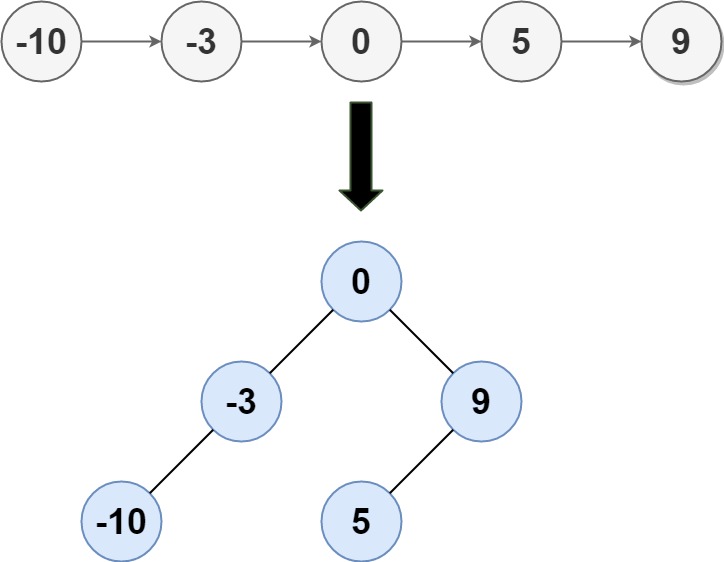
"""
from typing import Optional
class ListNode:
def __init__(self, val=0, next=None):
self.val = val
self.next = next
class TreeNode:
def __init__(self, val=0, left=None, right=None):
self.val = val
self.left = left
self.right = right
def sortedListToBST(head: Optional[ListNode]) -> Optional[TreeNode]:
if not head:
return None
def find_mid(head: ListNode) -> ListNode:
prev = None
slow = head
fast = head
while fast and fast.next:
prev = slow
slow = slow.next
fast = fast.next.next
if prev:
prev.next = None
return slow
mid = find_mid(head)
node = TreeNode(mid.val)
if head == mid:
return node
node.left = sortedListToBST(head)
node.right = sortedListToBST(mid.next)
return node
head = ListNode(-10)
head.next = ListNode(-3)
head.next.next = ListNode(0)
head.next.next.next = ListNode(5)
head.next.next.next.next = ListNode(9)
root = sortedListToBST(head)
assert root.val == 0
assert root.left.val == -3
assert root.left.left.val == -10
assert root.right.val == 9
assert root.right.left.val == 5
print("All passed")
# 0
# / \
# -3 9
# / /
# -10 5
538. Convert BST to Greater Tree
"""

"""
from typing import Optional
from binarytree import build
class TreeNode:
def __init__(self, val=0, left=None, right=None):
self.val = val
self.left = left
self.right = right
def convertBST(root: Optional[TreeNode]) -> Optional[TreeNode]:
prev = 0
def dfs(node):
if not node:
return None
nonlocal prev
dfs(node.right)
node.val += prev
prev = node.val
dfs(node.left)
dfs(root)
return root
root = [4, 1, 6, 0, 2, 5, 7, None, None, None, 3, None, None, None, 8]
root = build(root)
print(root)
# ____4__
# / \
# 1 6
# / \ / \
# 0 2 5 7
# \ \
# 3 8
greater_tree = convertBST(root)
print(greater_tree)
# _______30___
# / \
# _36 _21
# / \ / \
# 36 35 26 15
# \ \
# 33 8
230. Kth Smallest Element in a BST
from typing import Optional

from binarytree import Node as TreeNode
from binarytree import build


# Recursive
def kthSmallestRecursive(root: Optional[TreeNode], k: int) -> int:
    inorder = []

    def dfs(node):
        if not node:
            return None
        dfs(node.left)
        inorder.append(node.val)
        dfs(node.right)

    dfs(root)
    return inorder[k - 1]


# Iteratve
def kthSmallestIteratve(root: Optional[TreeNode], k: int) -> int:
    stack = []
    while True:
        while root:
            stack.append(root)
            root = root.left
        root = stack.pop()
        k -= 1
        if not k:
            return root.val
        root = root.right


if __name__ == "__main__":
    root = build([3, 1, 4, None, 2])
    k = 1
    assert kthSmallestRecursive(root, k) == 1
    assert kthSmallestIteratve(root, k) == 1
173. Binary Search Tree Iterator
from typing import Optional

from binarytree import Node as TreeNode
from binarytree import build


# BST
class BSTIterator:

    def __init__(self, root: Optional[TreeNode]):
        self.stack = []
        self._leftmost_inorder(root)

    def _leftmost_inorder(self, root):
        while root:
            self.stack.append(root)
            root = root.left

    def next(self) -> int:
        topmost_node = self.stack.pop()

        if topmost_node.right:
            self._leftmost_inorder(topmost_node.right)

        return topmost_node.val

    def hasNext(self) -> bool:
        return len(self.stack) > 0


root = build([7, 3, 15, None, None, 9, 20])
print(root)
#   7__
#  /   \
# 3     15
#      /  \
#     9    20
obj = BSTIterator(root)
print(obj.next())  # 3
print(obj.next())  # 7
print(obj.hasNext())  # True
1586. Binary Search Tree Iterator II 👑
from typing import Optional

from binarytree import Node as TreeNode
from binarytree import build


# BST
class BSTIterator:
    def __init__(self, root: Optional[TreeNode]):
        self.nodes = self._inorder(root)
        self.index = -1
        self.size = len(self.nodes)

    def _inorder(self, node):
        if not node:
            return []
        return self._inorder(node.left) + [node.val] + self._inorder(node.right)

    def hasNext(self) -> bool:
        return self.index < self.size - 1

    def next(self) -> int:
        self.index += 1
        return self.nodes[min(self.index, self.size - 1)]

    def hasPrev(self) -> bool:
        return self.index > 0

    def prev(self) -> int:
        self.index -= 1
        return self.nodes[max(self.index, 0)]


root = build([7, 3, 15, None, None, 9, 20])
print(root)
#   7__
#  /   \
# 3     15
#      /  \
#     9    20
obj = BSTIterator(root)
print(obj.next())  # 3
print(obj.next())  # 7
print(obj.hasNext())  # True
print(obj.prev())  # 3
print(obj.prev())  # None