Grid BFS
Table of Contents
- 1926. Nearest Exit from Entrance in Maze (Medium)
- 1091. Shortest Path in Binary Matrix (Medium)
- 1162. As Far from Land as Possible (Medium)
- 542. 01 Matrix (Medium)
- 994. Rotting Oranges (Medium)
- 1765. Map of Highest Peak (Medium)
- 934. Shortest Bridge (Medium)
- 2146. K Highest Ranked Items Within a Price Range (Medium)
- 1293. Shortest Path in a Grid with Obstacles Elimination (Hard)
- 909. Snakes and Ladders (Medium)
- 1210. Minimum Moves to Reach Target with Rotations (Hard)
- 675. Cut Off Trees for Golf Event (Hard)
- 749. Contain Virus (Hard)
- 1730. Shortest Path to Get Food (Medium) 👑
- 286. Walls and Gates (Medium) 👑
- 490. The Maze (Medium) 👑
- 505. The Maze II (Medium) 👑
- 499. The Maze III (Hard) 👑
- 317. Shortest Distance from All Buildings (Hard) 👑
- 2814. Minimum Time Takes to Reach Destination Without Drowning (Hard) 👑
1926. Nearest Exit from Entrance in Maze
from collections import deque
from typing import List


# BFS
def nearestExit(maze: List[List[str]], entrance: List[int]) -> int:
    m, n = len(maze), len(maze[0])
    directions = [(0, 1), (0, -1), (1, 0), (-1, 0)]
    q = deque([(entrance[0], entrance[1], 0)])
    maze[entrance[0]][entrance[1]] = "+"

    while q:
        r, c, steps = q.popleft()

        for dr, dc in directions:
            nr, nc = r + dr, c + dc

            if 0 <= nr < m and 0 <= nc < n and maze[nr][nc] == ".":
                if nr in [0, m - 1] or nc in [0, n - 1]:
                    return steps + 1
                q.append((nr, nc, steps + 1))
                maze[nr][nc] = "+"

    return -1


maze = [["+", "+", ".", "+"], [".", ".", ".", "+"], ["+", "+", "+", "."]]
entrance = [1, 2]
print(nearestExit(maze, entrance))  # 1
1091. Shortest Path in Binary Matrix
from collections import deque
from typing import List


# BFS
def shortestPathBinaryMatrix(grid: List[List[int]]) -> int:
    n = len(grid)
    if grid[0][0] == 1 or grid[n - 1][n - 1] == 1:
        return -1
    if n == 1:
        return 1

    directions = [
        (0, 1),
        (1, 0),
        (0, -1),
        (-1, 0),
        (1, 1),
        (-1, -1),
        (1, -1),
        (-1, 1),
    ]
    q = deque([(0, 0, 1)])  # (row, column, distance)
    grid[0][0] = 1

    while q:
        r, c, d = q.popleft()

        for dr, dc in directions:
            nr, nc = r + dr, c + dc
            if 0 <= nr < n and 0 <= nc < n and grid[nr][nc] == 0:
                if nr == nc == n - 1:
                    return d + 1
                q.append((nr, nc, d + 1))
                grid[nr][nc] = 1

    return -1


grid = [[0, 0, 0], [1, 1, 0], [1, 1, 0]]
print(shortestPathBinaryMatrix(grid))  # 4
1162. As Far from Land as Possible
from collections import deque
from typing import List


# BFS
def maxDistance(grid: List[List[int]]) -> int:
    n = len(grid)
    res = -1
    dirs = [[1, 0], [0, 1], [-1, 0], [0, -1]]

    q = deque([[i, j] for i in range(n) for j in range(n) if grid[i][j] == 1])

    if len(q) == (n**2):
        return res

    while q:
        size = len(q)
        for _ in range(size):
            r, c = q.popleft()
            for dr, dc in dirs:
                nr, nc = dr + r, dc + c
                if 0 <= nr < n and 0 <= nc < n and grid[nr][nc] == 0:
                    grid[nr][nc] = 1
                    q.append([nr, nc])
        res += 1

    return res


grid = [[1, 0, 0], [0, 0, 0], [0, 0, 0]]
print(maxDistance(grid))  # 4
542. 01 Matrix
from collections import deque
from typing import List


# BFS
def updateMatrix(mat: List[List[int]]) -> List[List[int]]:
    m, n = len(mat), len(mat[0])
    directions = [(0, 1), (0, -1), (1, 0), (-1, 0)]
    dist = [[float("inf")] * n for _ in range(m)]
    q = deque()

    for i in range(m):
        for j in range(n):
            if mat[i][j] == 0:
                dist[i][j] = 0
                q.append((i, j))

    while q:
        r, c = q.popleft()

        for dr, dc in directions:
            nr, nc = r + dr, c + dc
            if 0 <= nr < m and 0 <= nc < n and dist[nr][nc] > dist[r][c] + 1:
                dist[nr][nc] = dist[r][c] + 1
                q.append((nr, nc))

    return dist


mat = [[0, 0, 0], [0, 1, 0], [1, 1, 1]]
print(updateMatrix(mat))
# [[0, 0, 0], [0, 1, 0], [1, 2, 1]]
994. Rotting Oranges
"""
- Return the minimum number of minutes that must elapse until no cell has a fresh orange.
- Hint: Multi-source BFS to count the level.
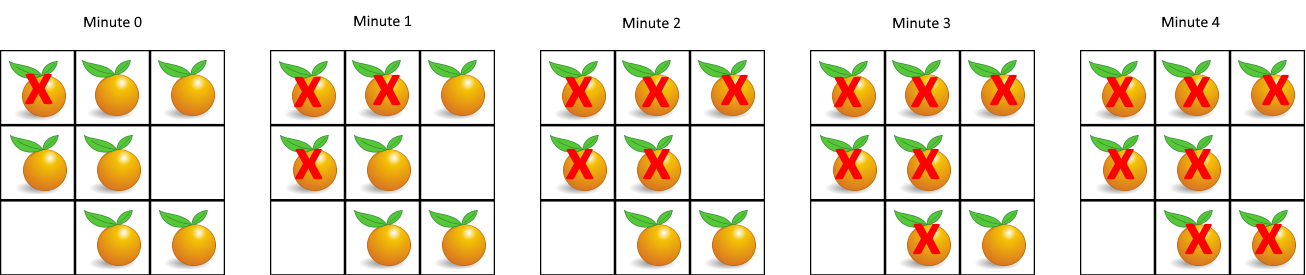
"""
from collections import deque
from typing import List
# BFS
def orangesRotting(grid: List[List[int]]) -> int:
m, n = len(grid), len(grid[0])
fresh = 0
q = deque()
dirs = [[1, 0], [0, 1], [0, -1], [-1, 0]]
for i in range(m):
for j in range(n):
if grid[i][j] == 2:
q.append([i, j])
elif grid[i][j] == 1:
fresh += 1
res = 0
while q and fresh > 0:
size = len(q)
for _ in range(size):
r, c = q.popleft()
for dr, dc in dirs:
nr, nc = dr + r, dc + c
if 0 <= nr < m and 0 <= nc < n and grid[nr][nc] == 1:
q.append([nr, nc])
grid[nr][nc] = 2
fresh -= 1
res += 1
return res if fresh == 0 else -1
grid = [[2, 1, 1], [1, 1, 0], [0, 1, 1]]
assert orangesRotting(grid) == 4
1765. Map of Highest Peak
from collections import deque
from typing import List


class Solution:
    def highestPeak(self, isWater: List[List[int]]) -> List[List[int]]:
        m, n = len(isWater), len(isWater[0])
        dirs = [[0, 1], [1, 0], [-1, 0], [0, -1]]
        q = deque()

        for i in range(m):
            for j in range(n):
                if isWater[i][j] == 1:
                    q.append((i, j))
                    isWater[i][j] = 0  # water
                else:
                    isWater[i][j] = -1  # unvisited land

        height = 1
        while q:
            size = len(q)
            for _ in range(size):
                r, c = q.popleft()

                for dr, dc in dirs:
                    nr, nc = dr + r, dc + c
                    if 0 <= nr < m and 0 <= nc < n and isWater[nr][nc] == -1:
                        isWater[nr][nc] = height  # visited land height
                        q.append((nr, nc))
            height += 1

        return isWater
934. Shortest Bridge
from collections import deque
from typing import List


# BFS + DFS; Coloring
def shortestBridge(grid: List[List[int]]) -> int:
    n = len(grid)
    directions = [(0, 1), (0, -1), (1, 0), (-1, 0)]

    def dfs(r, c, queue):
        grid[r][c] = 2
        queue.append((r, c))
        for dr, dc in directions:
            nr, nc = r + dr, c + dc
            if nr in range(n) and nc in range(n) and grid[nr][nc] == 1:
                dfs(nr, nc, queue)

    q = deque()
    found = False
    for r in range(n):
        if found:
            break
        for c in range(n):
            if grid[r][c] == 1:
                dfs(r, c, q)
                found = True
                break

    steps = 0
    while q:
        m = len(q)
        for _ in range(m):
            r, c = q.popleft()
            for dr, dc in directions:
                nr, nc = r + dr, c + dc
                if nr in range(n) and nc in range(n):
                    if grid[nr][nc] == 1:
                        return steps
                    elif grid[nr][nc] == 0:
                        grid[nr][nc] = 2
                        q.append((nr, nc))
        steps += 1

    return -1


grid = [
    [1, 1, 1, 1, 1],
    [1, 0, 0, 0, 1],
    [1, 0, 1, 0, 1],
    [1, 0, 0, 0, 1],
    [1, 1, 1, 1, 1],
]
print(shortestBridge(grid))  # 1
2146. K Highest Ranked Items Within a Price Range
1293. Shortest Path in a Grid with Obstacles Elimination
909. Snakes and Ladders
1210. Minimum Moves to Reach Target with Rotations
675. Cut Off Trees for Golf Event
749. Contain Virus
1730. Shortest Path to Get Food 👑
286. Walls and Gates 👑
from collections import deque
from typing import List


# Multi-Source BFS
def wallsAndGates(rooms: List[List[int]]) -> None:
    """
    Do not return anything, modify rooms in-place instead.
    """
    m, n = len(rooms), len(rooms[0])
    visited = set()
    directions = [(0, 1), (0, -1), (1, 0), (-1, 0)]

    def addRoom(r, c):
        if 0 <= r < m and 0 <= c < n and (r, c) not in visited and rooms[r][c] != -1:
            q.append((r, c))
            visited.add((r, c))

    q = deque()
    for r in range(m):
        for c in range(n):
            if rooms[r][c] == 0:
                q.append((r, c))
                visited.add((r, c))

    dist = 0

    while q:
        for _ in range(len(q)):
            r, c = q.popleft()
            rooms[r][c] = dist

            for dr, dc in directions:
                addRoom(r + dr, c + dc)
        dist += 1


if __name__ == "__main__":
    rooms = [
        [2147483647, -1, 0, 2147483647],
        [2147483647, 2147483647, 2147483647, -1],
        [2147483647, -1, 2147483647, -1],
        [0, -1, 2147483647, 2147483647],
    ]
    wallsAndGates(rooms)
    assert rooms == [
        [3, -1, 0, 1],
        [2, 2, 1, -1],
        [1, -1, 2, -1],
        [0, -1, 3, 4],
    ]
490. The Maze 👑
from collections import deque
from typing import List


# BFS
def hasPathBFS(maze: List[List[int]], start: List[int], destination: List[int]) -> bool:
    m, n = len(maze), len(maze[0])
    dirs = [[1, 0], [0, 1], [-1, 0], [0, -1]]
    q = deque([start])
    maze[start[0]][start[1]] = -1

    while q:
        r, c = q.popleft()
        if [r, c] == destination:
            return True

        for dr, dc in dirs:
            nr, nc = r, c

            while 0 <= nr + dr < m and 0 <= nc + dc < n and maze[nr + dr][nc + dc] != 1:
                nr += dr
                nc += dc

            if maze[nr][nc] != -1:
                q.append([nr, nc])
                maze[nr][nc] = -1

    return False


maze = [
    [0, 0, 1, 0, 0],
    [0, 0, 0, 0, 0],
    [0, 0, 0, 1, 0],
    [1, 1, 0, 1, 1],
    [0, 0, 0, 0, 0],
]
start = [0, 4]
destination = [4, 4]
print(hasPathBFS(maze, start, destination))  # True
505. The Maze II 👑
-
Tags: Array, Depth First Search, Breadth First Search, Graph, Heap Priority Queue, Matrix, Shortest Path
import heapq
from typing import List


# Dijkstra
def shortestDistance(
    maze: List[List[int]], start: List[int], destination: List[int]
) -> int:
    directions = [(0, 1), (0, -1), (1, 0), (-1, 0)]
    m, n = len(maze), len(maze[0])

    dist = [[float("inf")] * n for _ in range(m)]
    dist[start[0]][start[1]] = 0

    heap = [(0, start[0], start[1])]

    while heap:
        d, r, c = heapq.heappop(heap)

        if [r, c] == destination:
            return d

        for dr, dc in directions:
            nr, nc, nd = r, c, d

            while 0 <= nr + dr < m and 0 <= nc + dc < n and maze[nr + dr][nc + dc] == 0:
                nr += dr
                nc += dc
                nd += 1

            if nd < dist[nr][nc]:
                dist[nr][nc] = nd
                heapq.heappush(heap, (nd, nr, nc))

    return -1


maze = [
    [0, 0, 1, 0, 0],
    [0, 0, 0, 0, 0],
    [0, 0, 0, 1, 0],
    [1, 1, 0, 1, 1],
    [0, 0, 0, 0, 0],
]
start = [0, 4]
destination = [4, 4]
print(shortestDistance(maze, start, destination))  # 12
499. The Maze III 👑
-
Tags: Array, String, Depth First Search, Breadth First Search, Graph, Heap Priority Queue, Matrix, Shortest Path
import heapq
from typing import List


# Dijkstra
def findShortestWay(maze: List[List[int]], ball: List[int], hole: List[int]) -> str:
    directions = [(-1, 0, "u"), (1, 0, "d"), (0, -1, "l"), (0, 1, "r")]
    m, n = len(maze), len(maze[0])

    dist = [[float("inf")] * n for _ in range(m)]
    dist[ball[0]][ball[1]] = 0

    paths = [[""] * n for _ in range(m)]
    paths[ball[0]][ball[1]] = ""

    heap = [(0, "", ball[0], ball[1])]

    while heap:
        d, path, x, y = heapq.heappop(heap)

        if [x, y] == hole:
            return path

        for dx, dy, direction in directions:
            nx, ny, nd = x, y, d

            while 0 <= nx + dx < m and 0 <= ny + dy < n and maze[nx + dx][ny + dy] == 0:
                nx += dx
                ny += dy
                nd += 1

                if [nx, ny] == hole:
                    break

            new_path = path + direction
            if nd < dist[nx][ny] or (nd == dist[nx][ny] and new_path < paths[nx][ny]):
                dist[nx][ny] = nd
                paths[nx][ny] = new_path
                heapq.heappush(heap, (nd, new_path, nx, ny))

    return "impossible"


maze = [
    [0, 0, 0, 0, 0],
    [1, 1, 0, 0, 1],
    [0, 0, 0, 0, 0],
    [0, 1, 0, 0, 1],
    [0, 1, 0, 0, 0],
]
ball = [4, 3]
hole = [0, 1]
print(findShortestWay(maze, ball, hole))  # "lul"